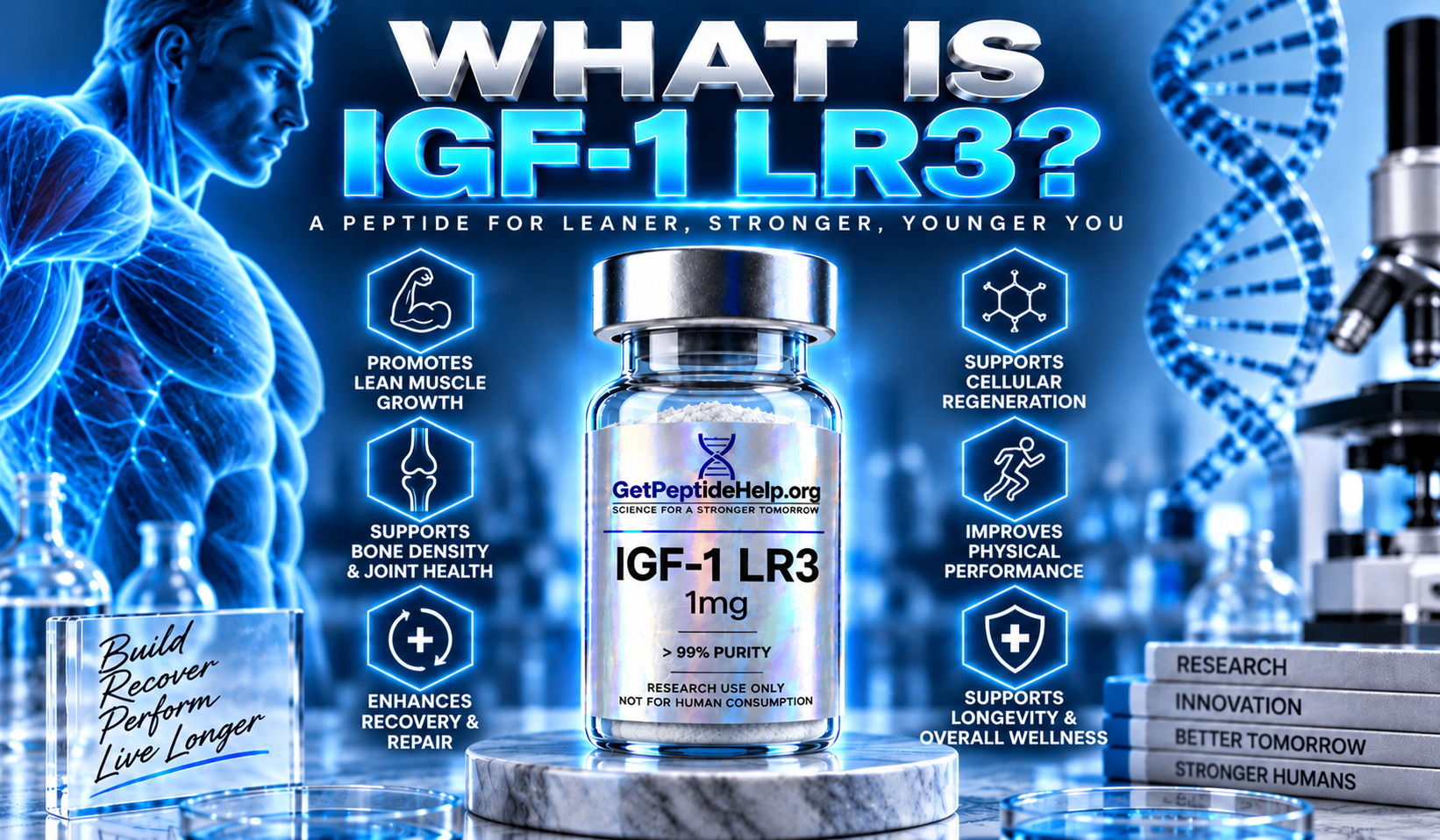
IGF-1: The Growth Factor That Actually Builds Muscle (And Why Your Body Isn’t Making Enough Anymore)
Let me tell you about the peptide hormone that’s responsible for pretty much EVERYTHING growth hormone gets credit for.
It’s called IGF-1 — Insulin-like Growth Factor 1.
And here’s what most people don’t understand:
When you hear about the “amazing benefits of growth hormone” — muscle growth, tissue repair, anti-aging effects, recovery…
That’s not actually growth hormone doing the work.
Growth hormone is basically just the messenger that tells your liver: “Hey, make more IGF-1.”
And THEN IGF-1 goes out and does all the heavy lifting.
So What IS IGF-1, Exactly?
Shop our sponsors Pyre Peptides for all of your peptide needs
It’s a peptide hormone that’s structurally similar to insulin (hence “insulin-like”).
Your liver produces most of it in response to growth hormone signals from your pituitary gland.
But here’s what’s interesting: nearly every tissue in your body ALSO produces some IGF-1 locally — right where it’s needed for growth and repair.
It’s not just floating around in your bloodstream. It’s being made on-site wherever your body needs to build, repair, or maintain tissue.
And When You’re Young? You’re Pumping This Stuff Out Like Crazy.
Which is why kids heal fast, build muscle easily, and seem to have limitless energy.
But as you age? IGF-1 production drops off significantly.
Which is exactly when you start noticing:
- Muscle getting harder to build and easier to lose
- Injuries taking forever to heal
- Recovery from workouts getting slower
- That general feeling of “not bouncing back like I used to”
Coincidence? Not even close.
Here’s How IGF-1 Actually Works In Your Body
It Activates Your Muscle Growth Pathways
IGF-1 binds to receptors on your cells (the IGF-1 receptor, specifically) and triggers two major signaling pathways:
PI3K/Akt pathway — drives protein synthesis and cell growth
MAPK/ERK pathway — promotes cell proliferation and survival
In plain English: it tells your muscles to GROW and tells your cells to STAY ALIVE instead of dying off.
In skeletal muscle specifically, IGF-1:
- Activates satellite cells (your muscle stem cells)
- Ramps up protein synthesis through the Akt/mTOR pathway
- Supports both muscle hypertrophy (size) and repair
This is the biological mechanism behind muscle growth. Not just “lift weights and hope.” This is the actual molecular switch that makes it happen.
It Keeps Your Cells Alive Longer
IGF-1 inhibits apoptosis — which is the technical term for programmed cell death.
Your cells are constantly dying off and being replaced. That’s normal.
But when IGF-1 levels are high, it protects cells from dying prematurely and supports tissue maintenance and repair.
This is part of why higher IGF-1 is associated with better recovery, healthier tissue, and slower aging (at least in terms of functional capacity).
It Has Metabolic Effects Too
Because IGF-1 is structurally similar to insulin, it can weakly activate insulin receptors.
Which means it has some glucose-lowering effects and influences how your body handles nutrients and energy.
Not as strong as insulin itself, but it’s part of the whole metabolic regulation picture.
The GH-IGF-1 Axis: How It All Connects
Here’s the sequence:
- Your pituitary gland releases growth hormone (GH)
- GH travels to your liver and signals it to produce IGF-1
- IGF-1 goes out and does all the actual work — muscle growth, tissue repair, anti-aging effects
So when people take growth hormone and see amazing results?
They’re really seeing the results of elevated IGF-1.
Which is why some people skip the middleman and just go straight to IGF-1 itself.
What People Are Actually Using IGF-1 For
Let’s be real about why this has become so popular in bodybuilding, biohacking, and anti-aging circles:
Muscle Growth and Hypertrophy
This is the big one.
IGF-1 — especially the synthetic variant IGF-1 LR3 (more on that in a second) — is used by bodybuilders and athletes specifically because it drives muscle growth at the cellular level.
Not through stimulants. Not through motivation. Through actual activation of muscle stem cells and protein synthesis pathways.
People report:
- Faster muscle gains
- Better recovery between workouts
- Ability to train harder and more frequently
- Muscle “fullness” and increased size
Recovery From Training and Injury
Because IGF-1 promotes tissue repair, people use it to:
- Bounce back faster from intense training
- Heal connective tissue (tendons, ligaments) after injury
- Reduce downtime between training sessions
This isn’t just anecdotal — the mechanism (satellite cell activation, protein synthesis, reduced apoptosis) explains exactly WHY it works for recovery.
Anti-Aging and Tissue Maintenance
As IGF-1 levels decline with age, so does your body’s ability to maintain and repair tissue.
People interested in longevity and anti-aging use IGF-1 to:
- Counteract age-related muscle loss (sarcopenia)
- Support bone density
- Maintain connective tissue health
- Keep recovery and repair mechanisms functioning like they did when they were younger
Wound and Connective Tissue Healing
This is actually one of the more scientifically supported uses.
IGF-1 has been shown to support healing of:
- Tendon injuries
- Ligament damage
- General wound healing
It’s not just bodybuilders using this. People with chronic injuries or slow-healing tissues are exploring it too.
Cognitive and Neuroprotective Interest
This one’s less mainstream, but there IS research interest around IGF-1’s role in:
- Neurogenesis (formation of new brain cells)
- Neuroprotection
- Cognitive function
The evidence here is thinner than the muscle/recovery stuff, but the mechanism is plausible and being actively studied.
IGF-1 vs. IGF-1 LR3: What’s The Difference?
Native IGF-1 has a short half-life and binds tightly to IGF-binding proteins (IGFBPs) in your blood, which limits its bioavailability.
IGF-1 LR3 is a synthetic analog designed to fix those problems:
- Longer-acting (stays in your system longer)
- Reduced binding to IGFBPs (more “free” IGF-1 available to work)
- More potent effects because of better bioavailability
This is what most people in the peptide community are actually using when they talk about IGF-1.
Now Here’s Where We Need To Get Real
IGF-1 is legitimately FDA-approved… but ONLY in one form (mecasermin/Increlex) and ONLY for severe primary IGF-1 deficiency in children.
Everything else — bodybuilding use, LR3 variants, anti-aging protocols — is off-label and unapproved.
It’s also banned in competitive sports (WADA-prohibited), so if you’re subject to drug testing, it’s completely off the table.
And There’s A Real Safety Concern You Need To Know About
IGF-1 promotes cell proliferation and inhibits cell death.
That’s great when you’re talking about muscle cells and tissue repair.
But it’s NOT great if you’re talking about cancer cells.
Elevated IGF-1 levels have been epidemiologically associated with increased risk of certain cancers — particularly prostate, breast, and colorectal cancers in some studies.
Does that mean IGF-1 CAUSES cancer? Not necessarily.
But it COULD promote the growth of existing cancer cells or pre-cancerous cells because it’s literally designed to make cells grow and not die.
This is a legitimate concern, not just fear-mongering.
Which is why unsupervised, long-term use of supraphysiological IGF-1 levels is something you need to take seriously and approach carefully.
So Who Should (And Shouldn’t) Consider This?
You might be a candidate if:
✓ You’re serious about muscle growth and performance optimization
✓ You’re dealing with slow recovery from training or injury
✓ You’re experiencing age-related muscle loss and want to counteract it
✓ You understand the risks and are willing to monitor health markers
✓ You’re working with someone knowledgeable (not just winging it)
You should absolutely NOT use this if:
✗ You have any history of cancer or pre-cancerous conditions
✗ You’re subject to competitive drug testing
✗ You’re not willing to get regular health monitoring
✗ You’re looking for a “magic bullet” without understanding the mechanism and risks
The Bottom Line
IGF-1 is the actual downstream effector of growth hormone.
It drives muscle growth through satellite cell activation and mTOR signaling.
It promotes tissue repair and recovery.
It supports maintenance of muscle mass and bone density.
It has legitimate anti-aging applications in the right context.
But it also comes with real risks — particularly around cancer promotion — that you can’t ignore.
The FDA hasn’t approved it for bodybuilding or anti-aging use.
The research exists. The mechanism is well-understood. The results are real.
But this isn’t a casual decision.
If You’re Going To Explore This, Do It Right
Understand the mechanism.
Know the risks.
Source quality product.
Monitor your health markers regularly.
Work with people who actually know what they’re doing.
IGF-1 isn’t a toy. It’s a powerful growth factor that can produce incredible results… or serious problems if used carelessly.
Your body used to make plenty of this naturally.
The question is whether restoring those levels — carefully, intelligently, with full awareness of the risks — makes sense for YOUR goals and situation.
That’s a decision only you can make.
But now you know exactly what you’re dealing with.
Shop our sponsors Pyre Peptides for all of your peptide needs
A note on this content: This page is for educational and research purposes only, not medical advice. It doesn’t diagnose, treat, or prevent any condition. Consult a licensed healthcare professional before making any health-related decisions