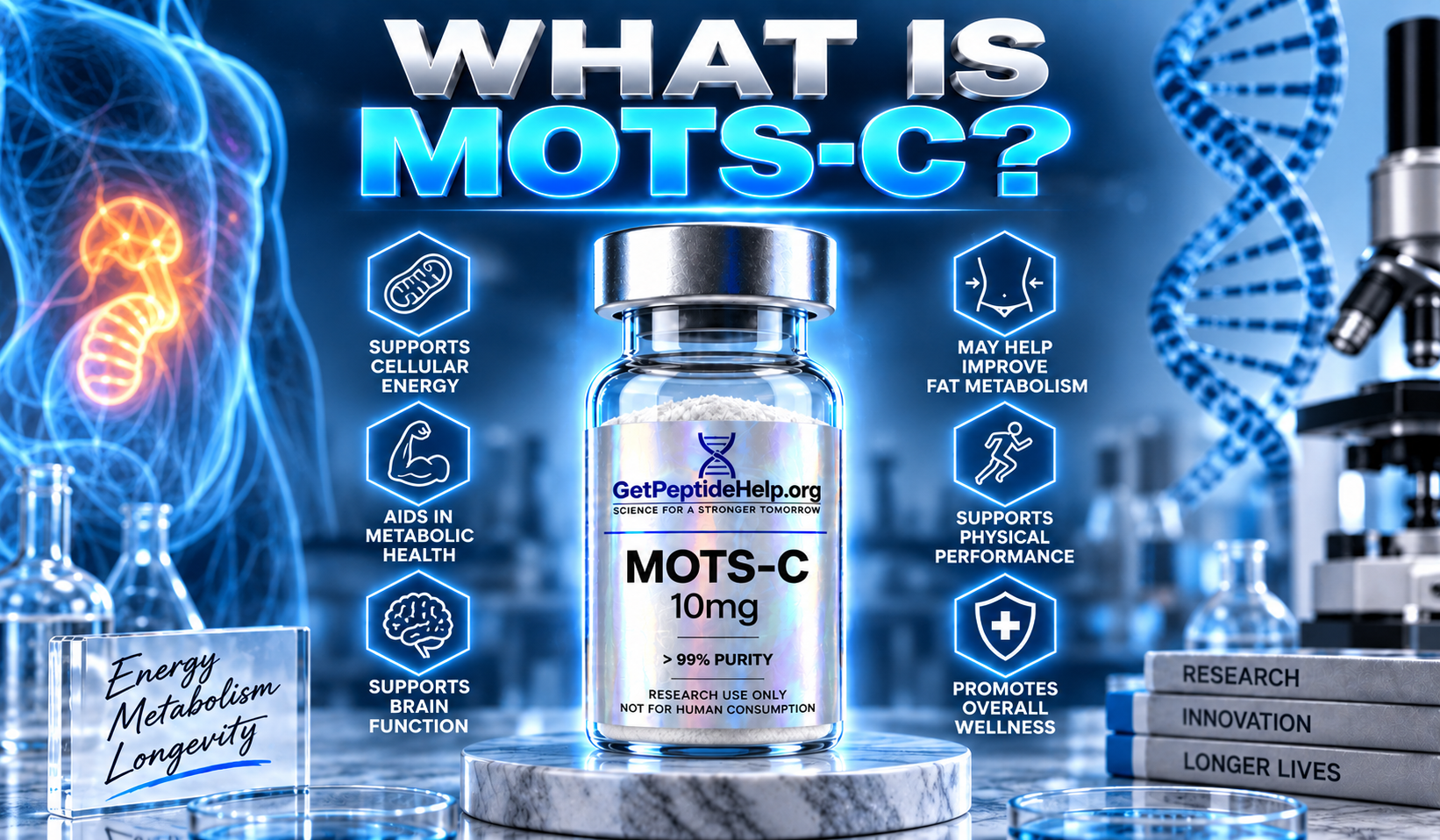
MOTS-c: The Mitochondrial Peptide That Might Be The Closest Thing We Have To An “Exercise Pill”
Alright, forget everything you think you know about anti-aging compounds and metabolic enhancers.
Because MOTS-c might be the most interesting peptide you’ve never heard of.
And here’s why it’s got researchers absolutely losing their minds…
This Thing Comes From YOUR MITOCHONDRIA
Most peptides are encoded in your regular DNA – the stuff in your cell nucleus that you learned about in high school biology.
MOTS-c? It’s encoded in your MITOCHONDRIAL DNA.
You know, those little powerhouses inside your cells that generate all your energy?
Turns out they’re not just energy factories. They’re also sending out molecular messengers that control how your entire body handles metabolism.
MOTS-c is one of those messengers.
And it’s basically like your mitochondria figured out how to text your cells instructions on how to burn fat, handle sugar, and stay young.
Here’s What Makes This So Damn Exciting
MOTS-c activates something called AMPK.
Now, unless you’re a biochemistry nerd, that probably means nothing to you.
So let me put it in terms that actually matter:
AMPK is your body’s “master energy switch.”
It’s what gets flipped on when you exercise hard. When you fast. When your body needs to get serious about burning stored energy instead of just coasting on whatever you just ate.
When AMPK gets activated, your body:
- Burns fat more efficiently
- Improves insulin sensitivity (so you handle carbs better)
- Boosts mitochondrial function (more energy, less fatigue)
- Starts acting like a younger, healthier version of yourself
Exercise activates AMPK.
Fasting activates AMPK.
And MOTS-c activates AMPK.
See where this is going?
They’re Literally Calling It An “Exercise Mimetic”
Translation: it mimics some of the metabolic benefits of exercise WITHOUT you having to actually exercise.
Now, before you get too excited – no, it’s not a magic “never work out again” pill.
But here’s what the research IS showing in animal models:
Mice given MOTS-c showed the SAME improvements in glucose handling as mice that were put through exercise training.
Read that again.
The peptide group got exercise-level metabolic improvements… without the exercise.
The Fat Loss Results? Absolutely Wild
In obese mice on high-fat diets, MOTS-c reduced fat accumulation significantly.
But here’s the kicker – it did it WITHOUT reducing their appetite.
They ate the same amount. But they didn’t get as fat.
That’s not appetite suppression. That’s not willpower. That’s genuine metabolic enhancement.
Your body is literally becoming more efficient at NOT storing fat.
And It Gets Even Better…
A brand new study from January 2026 showed something fascinating:
MOTS-c improved mitochondrial performance and reduced oxidative stress (that’s the cellular “rust” that ages you) WITHOUT increasing the number of mitochondria.
Translation: it made EXISTING mitochondria work better.
It’s like taking your current engine and somehow making it run 30% more efficiently without adding any new parts.
More energy output.
Less cellular damage.
Same hardware.
That’s efficiency optimization at the molecular level.
What This Actually Means For Your Body
Based on what researchers are seeing, MOTS-c appears to:
✓ Dramatically improve glucose handling and insulin sensitivity
(Your body gets better at processing carbs instead of storing them as fat)
✓ Reduce fat accumulation on a metabolic level
(Not through appetite suppression – through genuine metabolic enhancement)
✓ Protect pancreatic β-cells
(The cells that make insulin – crucial for preventing diabetes)
✓ Improve mitochondrial function in aging and diabetic conditions
(More cellular energy, less fatigue, better performance)
✓ Combat age-related insulin resistance
(The thing that makes you gain weight easier as you get older)
This Is Basically Metabolic Optimization In A Vial
Think about what normally happens as you age:
Your metabolism slows down.
Your insulin sensitivity gets worse.
Your mitochondria get sluggish.
Fat becomes easier to gain and harder to lose.
You have less energy.
Recovery takes longer.
MOTS-c appears to target ALL of those things at once.
Not through multiple mechanisms. Through ONE mechanism that controls everything else: AMPK activation and mitochondrial signaling.
It’s Not Just About Fat Loss
Yeah, the fat loss and metabolic stuff is incredible.
But the longevity angle? That’s where this gets REALLY interesting.
Because improving mitochondrial function isn’t just about having more energy today.
It’s about slowing the entire aging process.
Mitochondrial dysfunction is literally one of the hallmarks of aging. When your mitochondria start failing, everything else starts falling apart.
MOTS-c appears to keep them running efficiently.
Which means potentially:
- Better energy as you age
- Maintained metabolic health
- Protection against age-related metabolic diseases
- Possibly even extended healthspan (the years you’re actually healthy and functional, not just alive)
Now Here’s The Part Where I Have To Be Real With You
All of that amazing research I just told you about? It’s from animal studies and cell models.
We don’t have completed human clinical trials yet.
The data is INCREDIBLY promising. The mechanism makes perfect sense. The animal results are remarkable.
But technically speaking, this is still in the research phase for human use.
There WAS a clinical development program (called CB4211) that was exploring this… but it’s currently stalled.
So a mainstream therapeutic product? That’s probably years away.
Which Means Right Now, We’re In That Window Again
You know, that window where the data is out there, the mechanism is understood, the results are undeniable…
But it’s not officially approved yet.
Sound familiar?
It’s the same window that existed with BPC-157, with tirzepatide, with all the compounds that early adopters jumped on before they became mainstream.
The people who got in early on those? They don’t regret it.
A Few Important Things You Should Know:
MOTS-c is on WADA’s prohibited list (so if you’re a competitive athlete subject to drug testing, it’s off limits)
It’s currently ineligible for compounding under FDA rules, though there’s a review happening in July 2026 that could potentially change things
Quality and sourcing matters – like with any research peptide, you need to know what you’re getting and where it’s coming from
But Here’s What The Research Community Is Saying:
This is one of the most interesting mitochondrial peptides discovered in recent years.
The mechanism is elegant. The results are compelling. The potential applications span metabolic health, longevity, and performance.
And while we’re waiting for human trials to catch up with the animal data, there ARE people using this in research and self-experimentation contexts.
The Question Is: How Long Are You Willing To Wait?
You could wait 5-10 years for full FDA approval and mainstream availability.
By which point you’ll be 5-10 years older, with 5-10 more years of metabolic decline, mitochondrial aging, and fat accumulation.
OR…
You could be one of the people paying attention NOW.
Learning about it NOW.
Researching sources and quality NOW.
And potentially benefiting from it while everyone else is still reading headlines about “promising new research.”
Your Mitochondria Are Literally Trying To Tell Your Body How To Stay Young
MOTS-c is one of the messages they’re sending.
The question is whether you’re going to listen.
Or whether you’re going to wait until some regulatory body tells you it’s “officially okay” to pay attention to what your own mitochondria have been trying to tell you all along.
The data is there.
The mechanism is understood.
The potential is enormous.
What you do with that information is up to you.
A note on this content: This page is for educational and research purposes only, not medical advice. It doesn’t diagnose, treat, or prevent any condition. Consult a licensed healthcare professional before making any health-related decisions